
Events for October
30th

Events for November
1st
- 2
- 3
- 4
- 5
- 6
- 8
Events for November
2nd
Events for November
3rd
Events for November
4th
Events for November
5th
Events for November
6th
Events for November
7th

Native American Heritage Month Social & Stomp Dance
Events for November
8th
- 9
- 12
- 13
- 14
- 15
Events for November
9th
Events for November
10th
Events for November
11th

Events for November
12th
Events for November
13th
Events for November
14th
Events for November
15th
- 16
- 17
- 19
- 20
- 21
- 22
Events for November
16th
Events for November
17th
Events for November
18th

Waⁿdat Wednesday
Events for November
19th
Events for November
20th
Events for November
21st
Events for November
22nd
- 23
- 25
- 28
- 29
Events for November
23rd
Events for November
24th
Events for November
25th
Events for November
26th

Events for November
27th
Events for November
28th
Events for November
29th
- 30
- 1
- 2
- 3
- 4
- 5
- 6
Events for November
30th
About Us
The Wyandotte Nation is a federally recognized Native American tribe headquartered in Wyandotte, Okla.
Who are we?
The Wyandotte Nation consists of remnants of the Tionontati, Attignawantan and Wenrohronon (Wenro), all unique independent tribes, who united in 1649-50 after being defeated by the Iroquois Confederacy.
Our Symbol
- Turtle: Signifies the Tribe’s ancient belief the world was created on the back of a snapping turtle, also known as the “moss-back turtle.”
- Willow Branches: Because of its resilience after winter or famine, the Tribe’s ancestors believed the willow tree signified the perpetual renewal of life.
- War Club and Peace Pipe: Shows that the Tribe is ready for war or peace at any given moment.
- Council Fire: Many tribes of the Northeast looked upon the Tribe for leadership and advice, when they came together for council, the Tribe often hosted and presided over the councils and are considered “Keepers of the Council Fire.”
- Points of the Shield: Represent each of the Tribe’s 12 clans — Big Turtle, Little Turtle, Mud Turtle, Wolf, Bear, Beaver, Deer, Porcupine, Striped Turtle, Highland Turtle, Snake and Hawk.
A few interesting facts
- We were instrumental in the founding of Detroit, Mich., and Kansas City, Kansas. At one time Kansas City was named Wyandotte City.
- We adopted many white captives into the Nation. Many obtained high tribal status and made significant contributions to the betterment of the Tribe.
- During the French and Indian War, we sided with the French against the British. During the American Revolution, we sided with the British against the Americans.
- The Wyandot were the last tribe to leave Ohio in July of 1843.
- Twice we were terminated then reinstated as a tribe. In 1995, we were granted “self governance” by the Bureau of Indian Affairs.
- There are two other bands of Wyandot people, the Wyandot of Anderdon Nation located in Michigan, and the Wyandot Nation of Kansas. We are the same people separated by fate, the passing of time and choices made by our ancestors.
Here are some of the latest entries from our News & Events section.

Annual Performance Report for Housing available for review

Holiday Food Program

The TCAP Program is back; registration open now
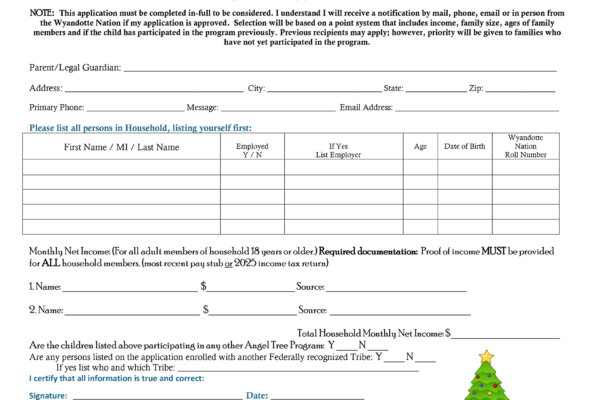
Wyandotte Nation Angel Tree Program

Wyandotte Nation Children’s Christmas Party set for Saturday, Dec. 12

Tribe closes on golf course, rebrands to Fire Ridge Golf Course
Meet the Chiefs
The Wyandotte Nation operates according to a 1999 constitution and by-laws.
The Tribe is governed by the Wyandotte Nation Council comprised of a Chief, Second Chief and 4 Council persons.


Services
The mission of the government of the Wyandotte Nation is to improve the quality of life for all tribal citizens. The Nation accomplishes this through providing quality governmental programs and services managed by sound decision-making and competent administration. Considering future generations and the protection of our tribal sovereignty, the Wyandotte Nation will utilize effective stewardship of our human, financial and natural resources. Concentration will be focused on development of strong leadership skills through education, accountability, experience and positive reinforcement.
Change of Address?


